

Agentic Commerce: The future of AI-driven payments
Digital commerce is entering a new phase.
As software becomes more autonomous, we are moving beyond clicks, forms, and manual checkouts towards a model where AI agents discover, decide, and transact on behalf of customers.
This evolution is known as: Agentic Commerce.
In this model, intent is delegated. Execution is automated. Payments happen in the background.
While Agentic Commerce is gaining momentum, it is often misunderstood. It is less about novelty and more about infrastructure.

What is Agentic Commerce?
Agentic Commerce describes a commerce model where AI agents act on behalf of customers to discover, decide, and pay for goods or services, within clearly defined rules and permissions.
agentic
adjective | uh-JEN-tik
Able to accomplish results with autonomy, used especially in reference to artificial intelligence.
Dictionary, Merriam-Webster, Agentic . Accessed January 2026.
These AI agents can:
- Search for products or services
- Compare options based on price, availability and customer preference
- Initiate and complete payments securely
- Learn from previous purchases to optimise future decisions
Rather than customers manually completing each step, AI agents manage the complete purchase journey.
The customer remains in control. The process becomes automated.
How Agentic Commerce works in practice
Consider an AI assistant managing everyday purchases.
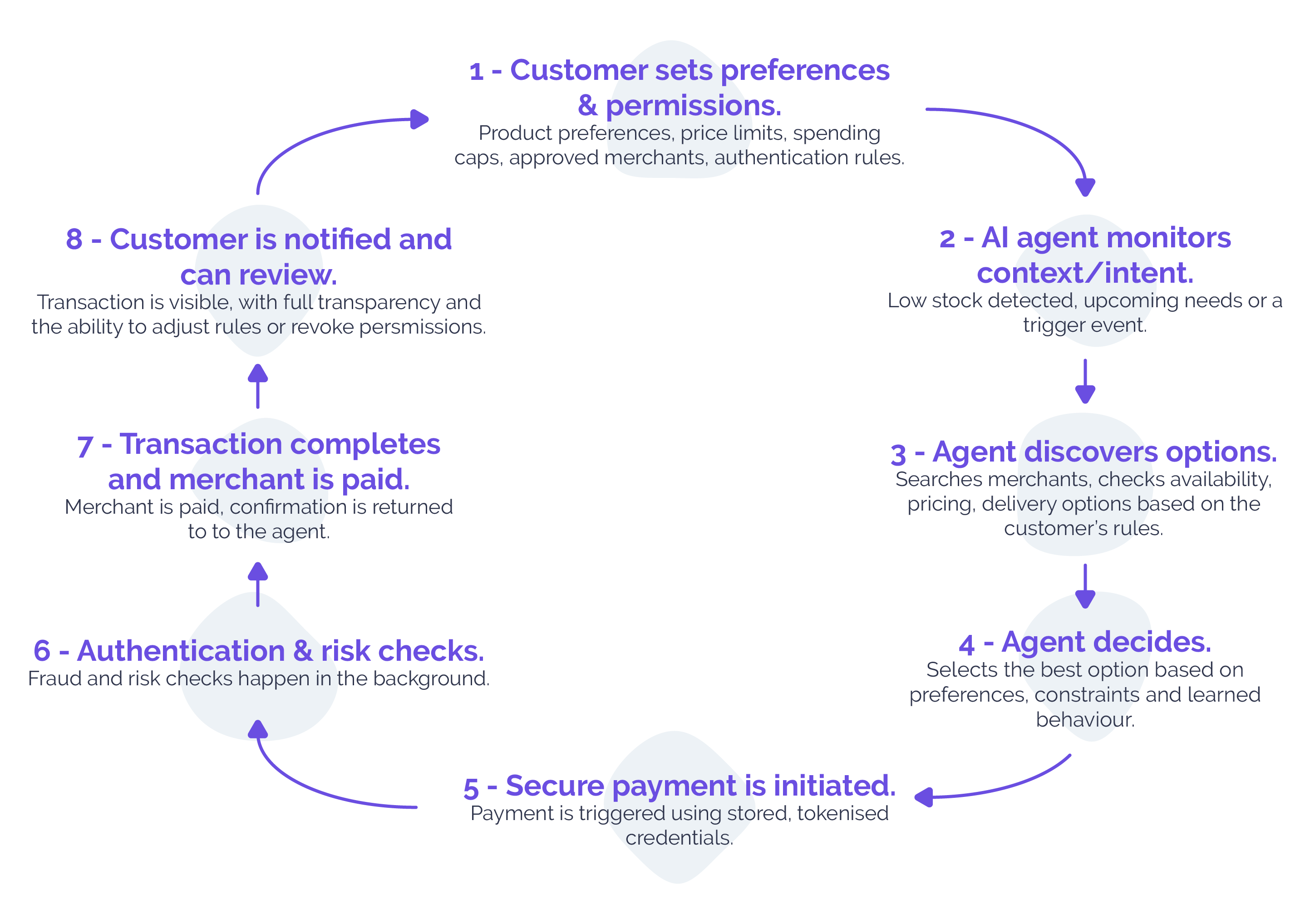
A customer defines preferences for coffee pods, including preferred brands, price range, retailers and delivery options. As supplies run low, the AI agent checks these preferences, identifies the right product and places the order.
Payment is completed automatically.
Every transaction is visible. Preferences, spending limits and permissions can be reviewed or revoked at any time.
Automation does not remove control. It requires it.
Trust is the deciding factor
Payments are often where customers first adopt new technology. We have seen this with the adoption of contactless payments and alternative payment devices, such as smartwatches.
Adoption is driven by trust.
Customers are comfortable when strong safeguards exist (think authentication methods like 3D Secure 2). Agentic Commerce introduces new efficiencies, but also higher expectations around security, transparency and accountability.
Key considerations include:
- Maintaining customer trust and loyalty
- Preventing exploitation by bad actors
- Adapting fraud detection for agent-initiated transactions
Without trust, automation does not scale.
Why Agentic Commerce matters
When implemented responsibly, Agentic Commerce can:
- Reduce friction across the payment journey
- Enable new, contextual customer experiences
- Support recurring and proactive purchases
- Shift commerce from reactive to intelligent.
As customers delegate intent to software, consent, transparency and security become non-negotiable.
The reality check
Agentic Commerce represents a shift from customer-driven interactions to AI-driven actions.
True agent-driven transactions require:
- Strong identity and consent models
- Secure credential handling
- Interoperable payment rails
- Infrastructure that supports automation without increasing fraud risk
This is not about bolting AI onto your checkout. It is about building the right foundations.

The foundation of Agentic Commerce: Network Tokenisation
Network tokenisation is a key enabler of Agentic Commerce.
While it does not replace customer authentication, transactions using Network Tokens are often viewed more favourably by issuing banks. Tokens are created and governed by the card schemes, increasing confidence in the security and integrity of each transaction.
By replacing sensitive card details with network-issued tokens:
- Credentials are stored and used securely
- Fraud risk is reduced
- Transactions are more resilient across channels and use cases
- Automated payments can operate safely at scale
In a world where software (not humans) initiates payments, secure, tokenised credentials are essential infrastructure.
When Agentic Commerce becomes mainstream, the foundations will matter more than the buzzwords.
Looking ahead
Agentic Commerce is not a single feature. It is an evolution.
At Judopay, we support Network Tokenisation for businesses today. Our focus is on building responsibly, using proven, network-level capabilities that improve security and performance today, while enabling more autonomous payment flows in the future.
This means:
- Higher authorisation rates and improved security
- Future-proofed payment credentials
- Infrastructure ready for agent-driven commerce
Interested in Network Tokenisation?
Explore our documentation or speak to our team to learn more.


.jpg)


